The 1992 Winter Olympic Games in Albertville
Discover the 1992 Albertville Winter Olympics: fierce competition, remarkable performances and historic results.

The 1992 Winter Olympic Games, officially known as the XVI Olympic Winter Games, took place in Albertville, in the Savoie department of France, from 8 to 23 February 1992. The organisers designated the event as the Albertville and Savoie Games. They were the last Winter Games to be held in the same year as the Summer Games (Barcelona). Seven cities competed for the right to host these Winter Games, and it was on the sixth round of voting that the French bid won the votes of the International Olympic Committee (IOC). The two co-presidents of the Albertville Games organising committee were Jean-Claude Killy and Michel Barnier. They were the third Winter Games to be held in France, after the first in Chamonix in 1924 and Grenoble in 1968.
The competition and disciplines
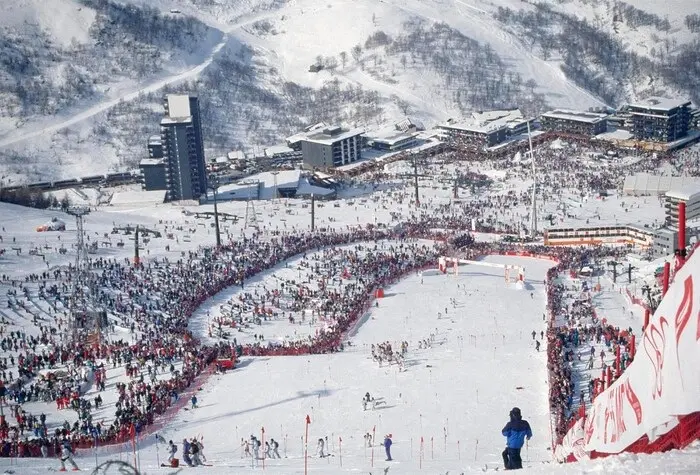
These Winter Games brought together 1,801 athletes from 64 nations, competing in six sports and 57 events. From now on, freestyle skiing, short track speed skating and women's biathlon were official disciplines. In addition, three disciplines — speed skiing, curling and the freestyle ski jumping and ballet events — were on the programme as demonstrations. Curling and freestyle ski jumping would later remain on the Winter Games programme. Albertville was the seat of the organisation of these Games, but the city actually hosted only 18 events. The other venues were spread across the Tarentaise and Beaufortain valleys, notably alpine skiing in Val d'Isère and Les Ménuires for men and Méribel for women, while cross-country skiing and biathlon events took place at Col des Saisies. This was a multi-polar organisation between the host city and the department, since the Games were jointly directed by the president of the General Council of Savoie — a co-management also reflected in the official name of the event, "Albertville and Savoie Games".
1992 Winter Olympics medal table
At the 1992 Albertville Winter Games, 171 medals were awarded across the twelve disciplines, totalling 57 events. Twenty of the sixty-four participating nations won at least one medal, as listed below. Among them, fourteen countries took at least one gold medal, and seventeen nations claimed more than one medal.
The German team dominated the medal table with an impressive total of 26 medals, closely followed by the Unified Team (Soviet Socialist Republics, that is Russia, Ukraine, Kazakhstan, Belarus, Uzbekistan and Armenia) with 23 medals. Norway also delivered a remarkable performance, taking 20 medals and finishing third overall.
As the host nation, France took seventh place with nine medals, equalling its record set at the 1968 Grenoble Games. This was a significant improvement on the two medals won at the 1988 Calgary Games.
| Rank | Nation | Gold | Silver | Bronze | Total |
|---|---|---|---|---|---|
| 1 | Germany | 10 | 10 | 6 | 26 |
| 2 | Unified Team (former USSR) | 9 | 6 | 8 | 23 |
| 3 | Norway | 9 | 6 | 5 | 20 |
| 4 | Austria | 6 | 7 | 8 | 21 |
| 5 | United States | 5 | 4 | 2 | 11 |
| 6 | Italy | 4 | 6 | 4 | 14 |
| 7 | France | 3 | 5 | 1 | 9 |
| 8 | Finland | 3 | 1 | 3 | 7 |
| 9 | Canada | 2 | 3 | 2 | 7 |
| 10 | South Korea | 2 | 1 | 1 | 4 |
| 11 | Japan | 1 | 2 | 4 | 7 |
| 12 | Netherlands | 1 | 1 | 2 | 4 |
| 13 | Sweden | 1 | 0 | 3 | 4 |
| 14 | Switzerland | 1 | 0 | 2 | 3 |
| 15 | China | 0 | 3 | 0 | 3 |
| 16 | Luxembourg | 0 | 2 | 0 | 2 |
| 17 | New Zealand | 0 | 1 | 0 | 1 |
| 18 | Czechoslovakia | 0 | 0 | 3 | 3 |
| 19 | North Korea | 0 | 0 | 1 | 1 |
| 20 | Spain | 0 | 0 | 1 | 1 |
French medals
The French Olympic team shone at the Olympic Games, winning a total of 9 medals — 3 gold, 5 silver and 1 bronze — earning seventh place in the medal table. Among the gold medallists were Anne Briand, Véronique Claudel and Corinne Niogret in biathlon for the women's 3 × 7.5 km relay event. Fabrice Guy also took gold in Nordic combined in the men's event. Edgar Grospiron stood out in freestyle skiing, taking gold in the men's moguls event.
The silver medals were won by Sylvain Guillaume in Nordic combined, Isabelle and Paul Duchesnay in figure skating in the ice dancing event, Olivier Allamand in freestyle skiing in the men's moguls event, and Carole Merle in alpine skiing in the women's super-G event. Franck Piccard also took silver in men's downhill in alpine skiing.
Finally, the bronze medal was won by Florence Masnada in alpine skiing in the women's combined event. These remarkable performances allowed the French team to stand out across various sporting disciplines at the Olympic Games.
The story of a challenge and a success
The Albertville Winter Olympics organising committee was created on 24 February 1987 under the official name of "Comité d'organisation des Jeux olympiques d'hiver d'Albertville et de la Savoie" (COJO). Michel Barnier was its president, with Jean-Claude Killy as co-president. The COJO had 31 members representing various sectors.
A memorandum of understanding was signed in November 1987 between the COJO, the French State and the Savoie department to fund the Games. The provisional budget was 3.176 billion francs. The Rhône-Alpes region also provided financial support.
To finance part of the expenses, the COJO set up a partnership with the private sector, creating the "Coubertin Club" bringing together sponsors. Other companies also contributed to the funding.
The financial assessment of the Games showed an initial deficit, but the positive impact on the modernisation of the region's infrastructure was highlighted during the celebrations of the twentieth anniversary of the Games.
The visual identity of the Games included an emblem representing an Olympic flame in the colours of Savoie, as well as a mascot, Magique, an elf in the shape of a star. An official sound identity was also defined, with music composed by Philippe d'Aram, used in various contexts linked to the Olympic Games.
Celebrations, conviviality and closing

The Albertville Winter Olympics took place from 8 to 23 February 1992. The opening and closing ceremonies, as well as 18 of the 57 events, took place in Albertville itself, while the other events were held in different ski resorts of the region — Les Arcs, Courchevel, Les Ménuires, Méribel, La Plagne, Pralognan-la-Vanoise, Les Saisies, Tignes and Val-d'Isère. The Olympic village was located in Brides-les-Bains, with press centres in Moûtiers and La Léchère. The host villages were Valmorel and La Tania.
The Olympic torch relay involved approximately 5,500 torchbearers, and the flame was lit on 14 December 1991 in Olympia, Greece. It travelled approximately 5,536 km before arriving in France, where it was received by the cycling champion Catherine Marsal at Paris-Charles-de-Gaulle airport. The last torchbearer, on its arrival in the stadium for the opening ceremony, was footballer Michel Platini, accompanied by a 9-year-old Savoyard, François-Cyrille Grange.
The opening ceremony, choreographed by Philippe Decouflé, took place on 8 February. It mixed traditional and artistic elements, with the participation of 1,808 athletes and officials from 64 nations. The evening also included artistic performances involving around 3,000 local artists, and ended with the lighting of the Olympic cauldron by Michel Platini, accompanied by François-Cyrille Grange.
The closing ceremony of the 1992 Albertville Winter Olympics was orchestrated by Philippe Decouflé. It respected Olympic protocol while integrating shows between the highlights. After a dance and acrobatics performance, all athletes entered the arena behind their flag bearers. The mayor of Albertville symbolically handed over the Olympic flag to the mayor of Lillehammer, the host city of the next 1994 Winter Olympics. Cultural presentations from the Norwegian city took place in accordance with the Olympic Charter.
Then, 19 folkloric groups from the two Savoyard departments were invited to perform. More than 300 dancers presented traditional dances, joined by more than 300 children from Albertville schools. Meanwhile, mountain guides descended the flagpole. President Samaranch delivered the closing speech, followed by the extinguishing of the flame. A fireworks display concluded the ceremony, followed by a great public ball. Co-president Jean-Claude Killy expressed his satisfaction by declaring: "Happy is the society capable of such a celebration."
Official events
- Biathlon: The biathlon events took place at Les Saisies, with six events on the programme for men and women.
- Bobsleigh: The two-man and four-man bobsleigh events took place at La Plagne.
- Nordic combined: Individual and team events took place in Courchevel.
- Ice hockey: The ice hockey matches were held in Méribel.
- Luge: Men's and women's events took place in La Plagne.
- Figure skating: Figure skating competitions took place in the Albertville Olympic Hall.
- Speed skating: Speed skating events took place on a temporary ring in Albertville.
- Short track speed skating: These events also took place in the Albertville Olympic Hall.
- Ski jumping: Ski jumping events took place in Courchevel.
- Freestyle skiing: Moguls events took place in Tignes.
- Alpine skiing: The various alpine skiing events were spread between Val-d'Isère, Les Ménuires and Méribel.
- Cross-country skiing: Cross-country skiing events took place at Les Saisies.
Demonstration sports
- Curling: Curling was presented as a demonstration in Pralognan-la-Vanoise.
- Freestyle skiing: Ballet and ski jumping events in freestyle skiing were presented in Tignes.
- Speed skiing: Speed skiing events took place in Les Arcs 2000.
These Olympic Games were marked by exceptional performances and offered an international showcase to a varied range of winter sports.
Comments
No comments yet. Be the first!
Add a comment